Introduction
Most building accessory sourcing mistakes don’t happen because someone chose the wrong product. They happen because something got left off the list entirely, and it surfaces mid-installation, when a valve size doesn’t match the pipework, or a door hardware fire rating doesn’t meet code, or a shutoff valve nobody remembered to order holds up final inspection.
This checklist is built to prevent that. It’s organized by construction phase, not just product category, so you can pull it up at the right point in a project rather than trying to remember everything at the planning stage. Save it, print it, or keep it open on-site, it’s meant to be referenced repeatedly across projects, not read once.
How to Use This Checklist
Why it matters: Building accessories get sourced in waves, not all at once, and different phases need different things confirmed before work moves forward. This checklist follows that same phased structure, so each section maps to a specific point in a typical construction timeline.
Work through each phase before that stage of construction begins, not during it. Items flagged with a certification note should be verified against our guide on why SASO, ISO, and IEC certification actually matters before finalizing any supplier.
Phase 1: Pre-Construction and Planning Checklist
- Confirm which building accessory categories the project actually needs, plumbing materials, door hardware, tapes and sealants, hoses and pipes, rather than sourcing reactively as issues come up.
- Request certification documentation, SASO Certificate of Conformity, ISO certification, and IEC compliance where relevant, from every prospective supplier before shortlisting.
- Confirm whether suppliers are manufacturers or resellers, since this affects lead time, consistency, and technical support throughout the project.
- Gather technical specification sheets for every product category, valve pressure ratings, door hardware fire ratings, and hose thread standards, before finalizing quantities.
- Confirm bulk pricing, minimum order quantities, and delivery timelines against your actual project schedule, not just a general quote.
- Request sample units for key product categories before committing to full order volume.
Phase 2: Rough-In and MEP Installation Checklist
Why it matters: This phase covers everything that goes in before walls and finishes close up around it, meaning mistakes here are the most expensive to fix later.
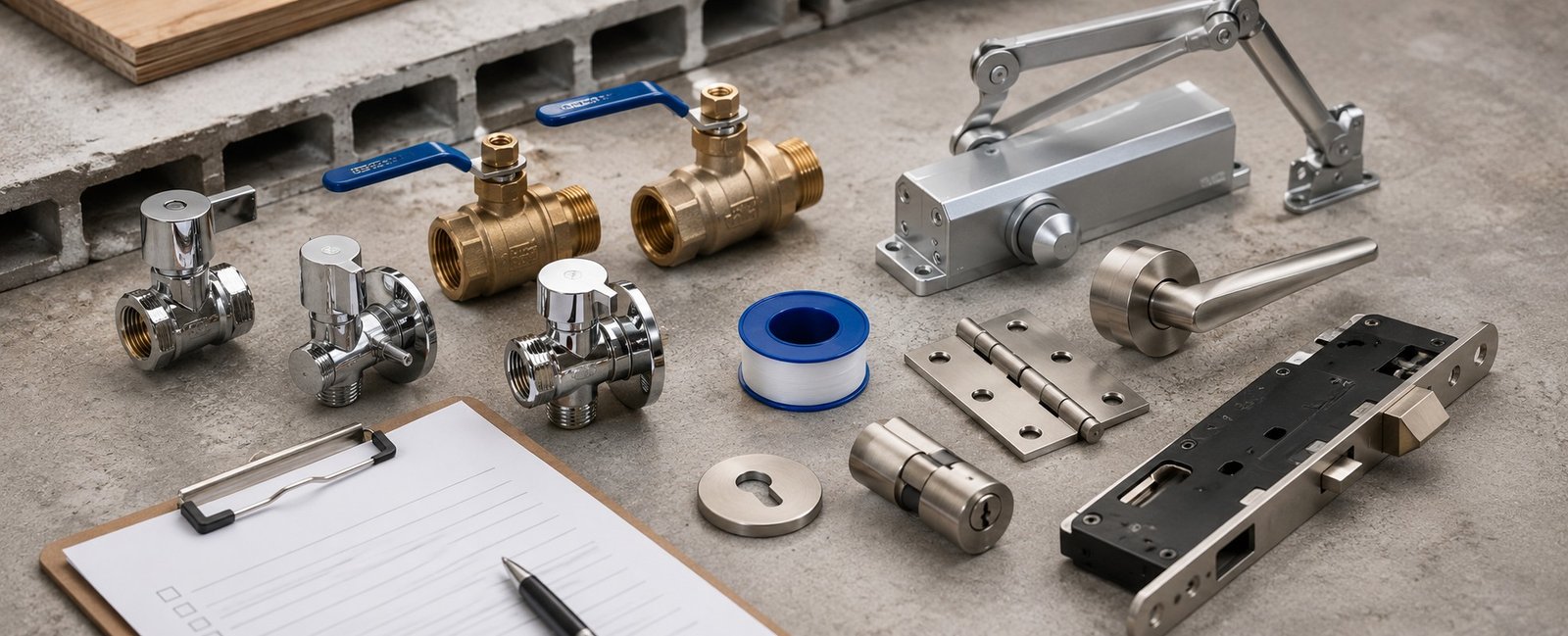
- Angle valves for every fixture supply line, confirmed in the correct size and material (brass, zinc, or stainless steel) for each application. See Kanzotech’s angle valve range.
- Ball valves for main shutoff points and zone isolation, sized and rated to match system pressure requirements. See our guide on how to choose the right ball valve for commercial buildings if the project includes commercial-grade requirements.
- Swing check valves installed anywhere backflow prevention is required, confirmed against the project’s plumbing design, not added as an afterthought. See Kanzotech’s swing check valve range.
- Bib cocks for all outdoor and utility connection points, material confirmed against exposure conditions. See Kanzotech’s bib cock range.
- Heater hoses sized correctly to the distance between each water heater and its wall connection point, thread type confirmed in advance. See Kanzotech’s heater hose range.
- Teflon tape stocked in sufficient quantity for every threaded connection across the project, not sourced piecemeal as installers run out. See Kanzotech’s Teflon tape range.
- Insulation tapes confirmed for any pipework requiring thermal or acoustic insulation per project spec. See Kanzotech’s insulation tape range.
- All rough-in plumbing components pressure tested before walls close, with certification documentation on file for inspection.
Phase 3: Door Hardware and Locking Systems Checklist
Why it matters: Door hardware requirements vary significantly by door type, location, and building use, and getting this wrong often isn’t discovered until final fit-out, when it’s far more disruptive to correct.
- Door closers specified for every door requiring controlled closing, confirmed against door weight and traffic frequency, particularly for commercial or high-traffic entries. See Kanzotech’s door closer range.
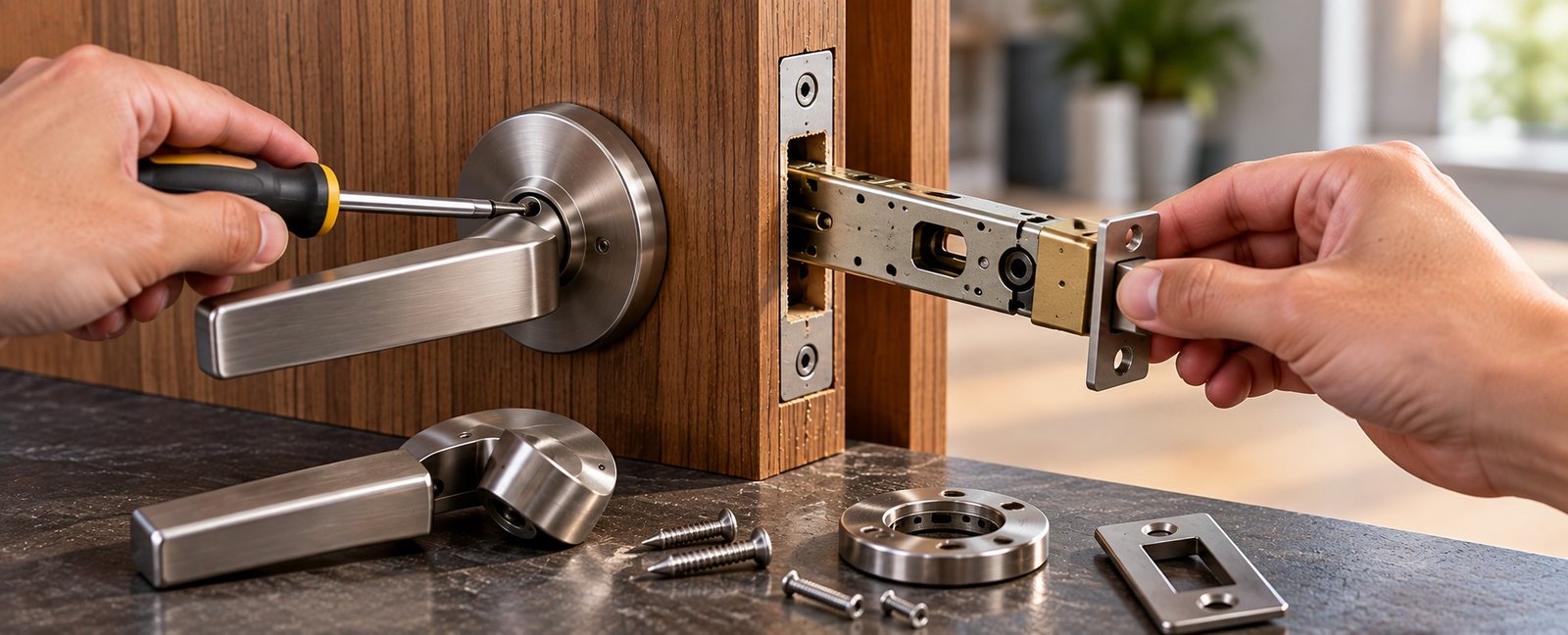
- Rim locks confirmed for all applicable doors, matched to security requirements by area, residential units, storage rooms, and restricted access points each typically need different specifications. See Kanzotech’s rim lock range.
- Complete door lock sets sourced consistently across similar door types, to simplify future maintenance and replacement parts sourcing. See Kanzotech’s door lock complete set range.
- Commercial vs. residential-grade hardware confirmed against actual use case for each door, not assumed based on building type alone. Our guide on commercial vs. residential door locks covers this distinction directly.
- If sourcing in bulk for a multi-unit development, confirm supplier packaging and labeling supports efficient distribution across units. Our guide on sourcing door hardware in bulk covers this in more depth.
- Spare parts and replacement components ordered alongside the main hardware order, not sourced separately after installation.
Phase 4: Finishing and Fit-Out Checklist
- Final hardware installation checked against the original specification sheet, confirming nothing was substituted without approval during construction.
- All threaded plumbing connections re-inspected for proper Teflon tape application before final closure.
- Door hardware function tested on every door, closers, locks, and rim locks operating smoothly before handover.
- Visible fittings inspected for finish consistency across units, particularly on multi-unit residential or hospitality projects where uniformity matters for presentation.
- Any damaged or defective units identified and flagged for replacement before final sign-off, not after occupancy.
Phase 5: Handover and Documentation Checklist
Why it matters: This is the phase most often rushed, and the one most likely to cause problems months or years later if skipped.
- Certification documentation, SASO Certificates of Conformity, ISO certificates, and relevant IEC compliance records, compiled and handed over as part of the project file.
- Warranty terms and documentation collected for every major product category, valves, door hardware, and any other significant components.
- Supplier contact information and reorder details recorded for future maintenance, particularly useful for developers managing multiple similar units or phases.
- A small stock of spare parts, washers, cartridges, matching hardware, retained on-site or with the facilities team for early maintenance needs.
- Product specification sheets archived alongside architectural and MEP documentation, so future renovation or maintenance work can match existing fittings accurately.
Quick Reference: The Condensed Checklist
For a fast, printable version to keep on-site:
Plumbing materials: Angle valves, ball valves, swing check valves, bib cocks, correctly sized and rated for each application.
Hoses and pipes: Heater hoses matched to installation distance and thread type.
Tapes: Teflon tape and insulation tape stocked in sufficient bulk quantity ahead of installation, not sourced as-needed.
Door hardware: Door closers, rim locks, and complete lock sets specified by door type, traffic level, and security requirement.
Documentation: SASO, ISO, and IEC certification on file for every regulated product category before handover.
Common Mistakes When Building a Bulk Accessories List
- Sourcing reactively instead of planning ahead, leading to rushed, inconsistent orders mid-construction that don’t match earlier specifications.
- Treating certification as a final-stage checkbox rather than confirming it during supplier selection, when it’s far easier to address.
- Underestimating consumables like Teflon tape, running short mid-installation and causing avoidable delays.
- Mismatching hardware grades to door use case, installing residential-grade hardware on high-traffic commercial doors, or vice versa.
- Skipping spare parts and documentation at handover, creating avoidable friction for facilities teams months down the line.
Frequently Asked Questions
- When should I start sourcing building accessories for a new construction project? Ideally during the pre-construction planning phase, well before rough-in begins, so certifications, specifications, and quantities are confirmed rather than sourced reactively once installation is already underway.
- What’s the biggest mistake developers make when planning building accessories? Sourcing reactively rather than following a phased checklist, which leads to mismatched specifications, certification gaps, and mid-project delays that are far more costly to fix than to plan for upfront.
- Should I order all building accessories from a single supplier? Where possible, consolidating plumbing materials, door hardware, tapes, and hoses under fewer, more capable manufacturers simplifies coordination, improves consistency, and often strengthens bulk pricing compared to managing multiple separate suppliers.
- What certification documents should I collect before project handover? SASO Certificates of Conformity, relevant ISO certification, and IEC compliance documentation where electrical components are involved, compiled and archived as part of the official project file.
- How do I know how many spare parts to order at handover? There’s no fixed rule, but a modest stock of commonly replaced components, washers, cartridges, and matching hardware, saves significant time for early maintenance needs without requiring a full reorder cycle.
- Does this checklist apply to residential and commercial projects equally? The overall phased structure applies to both, though specific product grades, particularly for door hardware, should be matched to the project’s actual use case and traffic level rather than applied uniformly.
Conclusion
A phased, checklist-driven approach to sourcing building accessories catches the gaps that cause real project delays, mismatched valve sizes, missing certification documentation, hardware that doesn’t match a door’s actual use case, before they become expensive problems mid-construction or at handover. Keep this checklist on hand for every new project, and the same planning discipline that prevents one project’s sourcing headaches will save time on every project that follows.
Your next steps:
- Work through each phase of this checklist before that stage of construction begins.
- Confirm certification documentation during supplier selection, not at handover.
- Explore Kanzotech’s full product catalogue to map your project’s requirements against our plumbing materials, door hardware, tapes, and hoses and pipes ranges.
Planning building accessories for a new construction project? Contact Kanzotech Accessories to request a bulk quotation and technical guidance for your full project scope.



 September 30, 2026
 HYZAM KENZ








Comments
No comments yet. Be the first to comment!