Introduction : Which is Better
Most valve purchasing decisions come down to habit. Contractors specify what they’ve always specified. Procurement teams reorder what’s on the approved list. And that’s usually fine until a system starts cycling more than expected, or a large diameter line needs isolating and the valve takes three minutes to close.
The ball valve vs gate valve choice isn’t complicated, but it does matter. These are two different tools designed for different jobs, and using one where the other belongs creates real operational problems over time , slower response, higher maintenance frequency, or accelerated seat wear. On large projects across Saudi Arabia’s oil and gas, infrastructure, and commercial construction sectors, the wrong specification compounds quickly.
This guide explains the difference between ball valve and gate valve clearly, covers where each one belongs, and gives you a straightforward framework for choosing the right option for your application.
The Core Difference: How Each Valve Actually Works
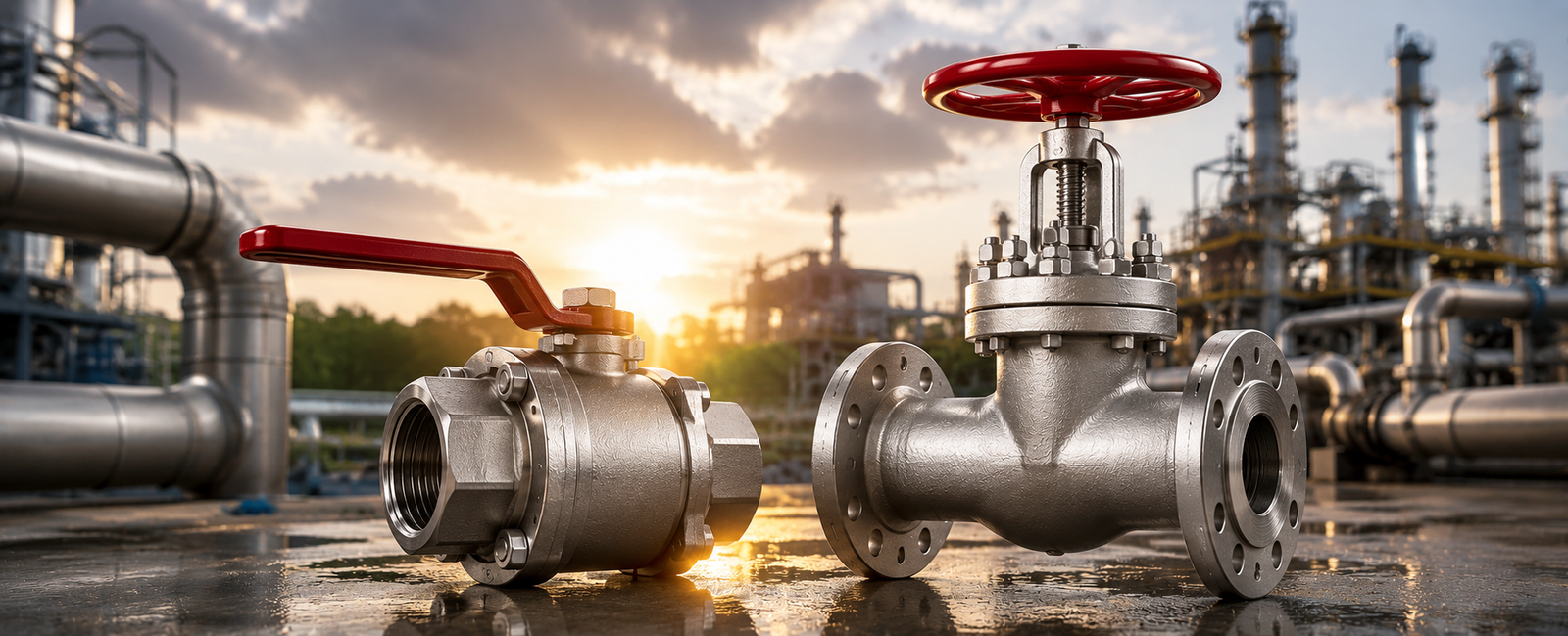
A ball valve uses a drilled spherical ball inside the valve body. Rotate the handle 90 degrees and the bore aligns with the pipe, full flow. Rotate it back and the solid face of the ball blocks flow completely. One quarter-turn, either direction, fully open or fully closed. That’s the entire operating mechanism.
A gate valve works differently. Turning the handwheel raises or lowers a metal gate , literally a sliding plate or wedge , that either blocks or clears the flow path. It takes multiple full rotations to go from closed to open. The upside is that when it’s fully open, the gate is completely clear of the flow path, leaving an unobstructed bore with virtually no pressure loss.
That single difference , quarter-turn vs multi-turn , drives most of the practical distinction between the two valve types.
Ball Valve vs Gate Valve: Side-by-Side Comparison

Where Ball Valves Win
Ball valves dominate in applications where speed, reliability, and automation matter.
The quarter-turn mechanism is the key. It’s simple enough that an electric or pneumatic actuator can automate it with minimal complexity, which is why ball valves are standard in process control, automated pipelines, and any system where valves need to open and close on a schedule or in response to system conditions.
They’re also the better choice anywhere a valve is operated frequently , daily or more. Gate valves weren’t designed for repeated cycling. Ball valves handle it without meaningful wear over long service periods.
Where you’ll find ball valves specified: petrochemical processing, oil and gas facilities, water treatment plants, compressed air systems, HVAC equipment rooms, pharmaceutical manufacturing, and building services isolation where fast shut-off is needed.
The trade-off is cost. A quality ball valve , particularly in larger sizes or stainless steel costs more upfront than a comparable gate valve. But when you factor in maintenance frequency and the labour cost of slower operation over a long service period, ball valves often deliver better total lifecycle value on high-use applications.
Where Gate Valves Win
Gate valves earn their place in a specific and important application: full-bore isolation on large diameter pipelines that don’t operate frequently.
When a gate valve is fully open, the gate is completely retracted from the flow path. There’s virtually no obstruction — pressure loss across a fully open gate valve approaches zero. On large transmission lines where even small pressure losses compound significantly over distance, that matters. It’s the reason gate valves remain the standard specification on municipal water distribution mains, fire protection systems, large utility networks, and major oil transmission pipelines across Saudi Arabia.
The operational constraint is real though. Gate valves aren’t for daily use. Repeated cycling wears the gate and seating surfaces, which eventually leads to sealing failure. They’re best treated as valves that stay open almost all the time and only close for maintenance or emergencies.
Where you’ll find gate valves specified: underground water mains, municipal distribution systems, large industrial pipelines, fire suppression infrastructure, and major transmission systems where infrequent operation is guaranteed.
The Decision Framework
If you’re still weighing which is the right choice, run through these three questions:
- How often will this valve operate? If the answer is daily, or on any kind of regular schedule, use a ball valve. If it’ll stay open almost permanently and only close for maintenance, a gate valve is fine.
- Does it need to automate? Ball valves integrate with actuators cleanly. If automation is on the table now or later, ball valve is the right specification.
- What’s the pipe diameter? For large-diameter mains, DN150 and above where pressure loss is the critical concern and operation is infrequent, gate valves make sense. For smaller diameters across most commercial and residential applications, ball valves are the better default.
For most modern building services, commercial developments, and industrial installations in Saudi Arabia, the answer is a ball valve. Gate valves remain the right call for large infrastructure and transmission applications where their specific advantages actually come into play.
Cost: Initial Price vs Lifecycle Value
Gate valves are cheaper to buy. That’s a genuine advantage for projects with tight materials budgets, and on large infrastructure contracts where hundreds of valves are being specified, the per unit difference adds up.
But initial cost isn’t total cost. Ball valves require less maintenance, fewer replacements, and in automated systems, lower actuator complexity. On applications where a valve operates frequently, the labour cost of maintaining a gate valve over five or ten years typically exceeds the upfront saving.
The honest answer is: for infrequent-use large-line isolation where gate valves genuinely belong, they offer real cost efficiency. For anything that cycles regularly, the lifecycle economics favour a ball valve.
Sourcing Valves for Projects in Saudi Arabia
Getting the specification right is step one. Getting reliable supply with the right certifications is step two and on regulated projects across the Kingdom, it matters.
Valves used in Saudi construction, oil and gas, and municipal infrastructure projects need to meet applicable standards, including SASO requirements for water-service products and API or ISO certifications for industrial applications. Suppliers should be able to provide material traceability documentation, conformance certificates, and genuine after-sales support not just a delivery and an invoice.
Kanzotech stocks a full range of valves and flow control products for residential, commercial, and industrial applications, with supply capacity for project volumes across Saudi Arabia. For specific valve requirements alongside broader plumbing materials procurement, the team can provide technical support and RFQ responses tailored to your project specification.
Industrial procurement teams and EPC contractors can review supply options on the Industrial Buyers and Contractors pages.
For pump installations where valve specification forms part of a larger piping system, Kanzotech Pumps covers water transfer pumps for construction, agricultural, and industrial applications across the Kingdom.
Frequently Asked Questions
1.Is a ball valve better than a gate valve?
For most modern applications — especially where the valve operates frequently or needs to automate — yes. Ball valves are faster, seal more reliably, and require less maintenance. Gate valves are better for large-diameter transmission pipelines where infrequent operation and zero flow restriction are the priorities.
2.What’s the biggest difference between a ball valve and a gate valve?
The operating mechanism. A ball valve opens and closes with a single quarter-turn. A gate valve requires multiple full rotations of the handwheel. That difference in operating speed drives most of the practical distinctions between the two types.
3.Can a gate valve regulate flow?
It’s not designed to. Gate valves are on/off isolation valves. Using them in a partially open position creates turbulence, accelerates wear on the gate and seats, and leads to sealing failure earlier than it should. For flow regulation, a globe valve or control valve is the right choice.
4.Which valve handles automation better?
Ball valves, clearly. Their quarter-turn mechanism allows direct coupling to electric or pneumatic actuators with minimal complexity. Automating a gate valve is possible but requires larger, more expensive actuators and more complex installation.
5.Which lasts longer in regular use?
Ball valves, for applications with frequent cycling. Gate valves can have very long service lives, but only in applications where they operate rarely. Frequent cycling wears gate valves out faster than equivalent ball valve use.
6.Where can I source valves for a project in Saudi Arabia?
Kanzotech supplies ball valves, gate valves, angle valves, and check valves for residential, commercial, and industrial projects across Saudi Arabia. Contact the team for project-specific RFQ support and bulk supply enquiries.



 September 30, 2026
 HYZAM KENZ




Comments
No comments yet. Be the first to comment!